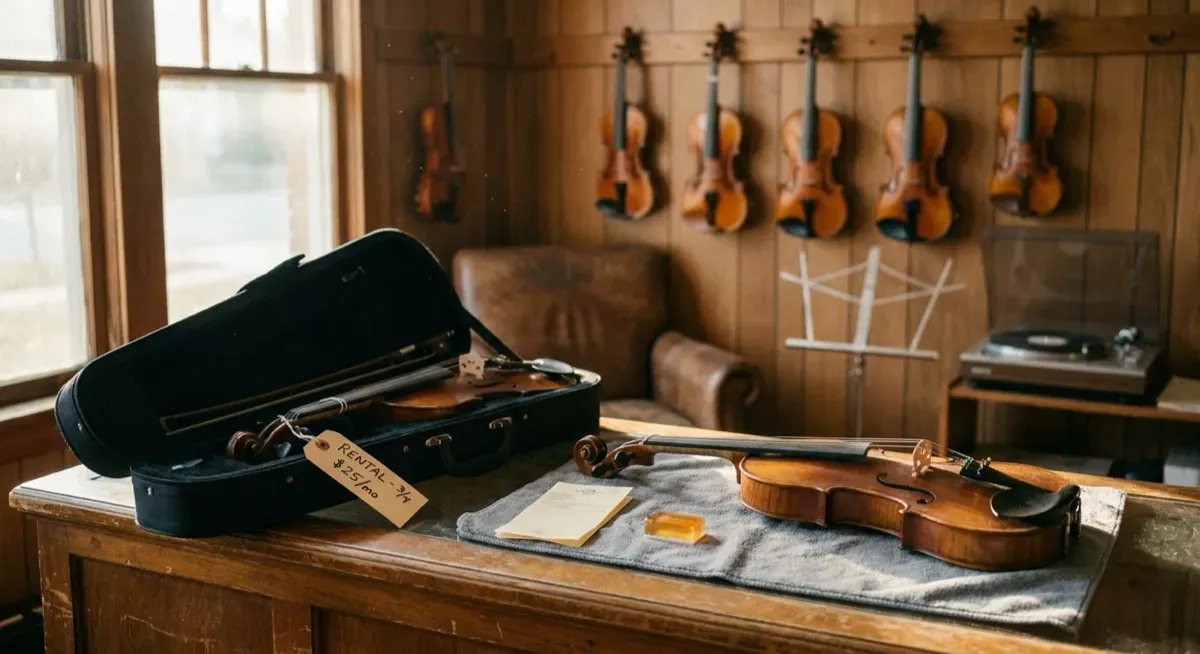
“Should I rent or buy?” I get this question before almost every first lesson. Usually with a follow-up. “And how do I not waste money?” I love this question because it means someone is serious about starting, and I want to make sure their first experience with the instrument is a good one.
Short answer. Rent first, almost always. But there are exceptions, and getting the wrong size or a bad instrument can genuinely set you back weeks. So let me walk you through it honestly, the way I’d talk to a friend.
Renting: The Safe Choice
Renting from a local music shop typically costs $25-50 per month. Most shops apply your rental payments toward a future purchase, so you’re not throwing money away. You’re basically test-driving.
Rent if:
- You’re not sure you’ll stick with it. No shame in that. Better to find out on a $30/month rental than a $300 purchase.
- Your child is still growing and will need a bigger size within a year
- You want a properly set up instrument without doing research
- You want the shop to handle repairs and adjustments
The biggest advantage is that the shop sets everything up for you. Bridge height, string action, tuning, all done by someone who knows violins and cares about them. That matters more than people realize. When you buy online, you often get an instrument that needs $50-100 of setup before it’s actually playable. And most beginners don’t know that, so they think the problem is them. It’s not.
Buying: When It Makes Sense
Buy if:
- You’re an adult and committed to learning, since your size won’t change
- You’ve been renting for a few months and you know this is for you
- You found a good deal through a teacher or string shop
For a decent student outfit, meaning violin, bow, case, and rosin, expect $150-300. Brands like Stentor or Eastman at this range are reliable and I’ve seen them last for years. Between $300-600 you get noticeably better tone and playability, which is nice but not necessary when you’re starting. Above $600 is intermediate territory. You don’t need that yet. Promise.
Here’s something I always tell my students. A $200 violin from a string specialty shop will outperform a $200 violin from Amazon every time. The shop sets it up. Amazon ships it in a box and hopes for the best. It’s the same price but a completely different experience.
What to Avoid
This is where I get a little passionate. Maybe more than a little. Please don’t buy these.
Ultra-cheap online violins in the $30-80 range. They look like violins in photos. They do not play like violins. Pegs slip every 30 seconds, the bridge is usually crooked, strings feel like razor wire against your fingers. I’ve had students bring these to lessons and we spend the entire time fighting the instrument instead of making music. It breaks my heart every time. It’s not worth saving $100 if it makes you want to quit.
Colored or novelty violins. I know that purple violin looks amazing on Instagram. It sounds terrible in your hands. I’m sorry. Start with a standard acoustic instrument and let your playing be the colorful part.
Untuned hand-me-downs without getting them checked first. Your grandmother’s violin from the attic might be beautiful, and I love that there’s a story behind it. But it probably needs new strings, a new bridge, and a sound post adjustment. Take it to a luthier before you try to play it. Repairs can run $100-200. Sometimes it’s worth every penny. Sometimes the rental is honestly cheaper. A luthier will tell you straight.
Getting the Right Size
This matters more than most people realize, and getting it wrong can cause real problems. Uncomfortable playing, bad technique habits, sometimes actual pain.
Violin sizes go by fractions, which I know is confusing. Measure the player’s arm by extending the left arm straight out to the side, and measure from the neck to the middle of the palm.
| Arm Length | Violin Size | Typical Age |
|---|---|---|
| 14-15.5” | 1/16 | 3-4 years |
| 15.5-17” | 1/10 | 4-5 years |
| 17-17.5” | 1/8 | 5-6 years |
| 17.5-20” | 1/4 | 6-7 years |
| 20-22” | 1/2 | 8-9 years |
| 22-23.5” | 3/4 | 10-12 years |
| 23.5”+ | 4/4, full size | 13+ and adults |
If you’re between sizes, go smaller. Always. A slightly small violin is much easier to play than a slightly large one. I see kids struggling with violins that are one size too big all the time. Their parents wanted them to “grow into it.” I understand the thinking, but it doesn’t work with violins. It just makes everything harder and less fun.
Where to Get Your First Violin
In order of what I recommend.
Local music shop with a rental program. Best option by far. They know violins, set them up properly, and exchange sizes as kids grow. Build a relationship with your local shop. It’ll pay off for years.
Online string specialty shops. Shar Music, Southwest Strings, Johnson String. These companies specialize in string instruments and ship properly set-up violins. Very different from a random Amazon listing.
Your teacher’s recommendation. Most violin teachers have connections with shops and can point you to the right instrument for your level and budget. Always worth asking. We love this question.
Avoid these. Amazon for violins under $200. Pawn shops unless you bring someone who plays to test it. eBay. Wish. Any listing that says “great for beginners!” with 47 five-star reviews and a $39 price tag. Those reviews are not from violinists.
My Honest Recommendation
Rent for 3-6 months. See how it feels. If you love it, and I hope you do, take your rental credit and buy from a string shop with your teacher’s input. If it turns out it’s not for you, return the rental and you’re out $100-150 instead of $300.
For kids, keep renting until they stop growing through sizes. The shop handles the swaps and you don’t end up with three old violins collecting dust in the closet. I’ve seen this more times than I can count.
I cover violin setup, how to put on tapes and tune, in the third video of my free beginner series. Worth watching before your first practice session, whether you rent or buy.
Not sure what you need? Book a lesson and I’ll help you figure it out. I genuinely enjoy helping people find their first instrument.