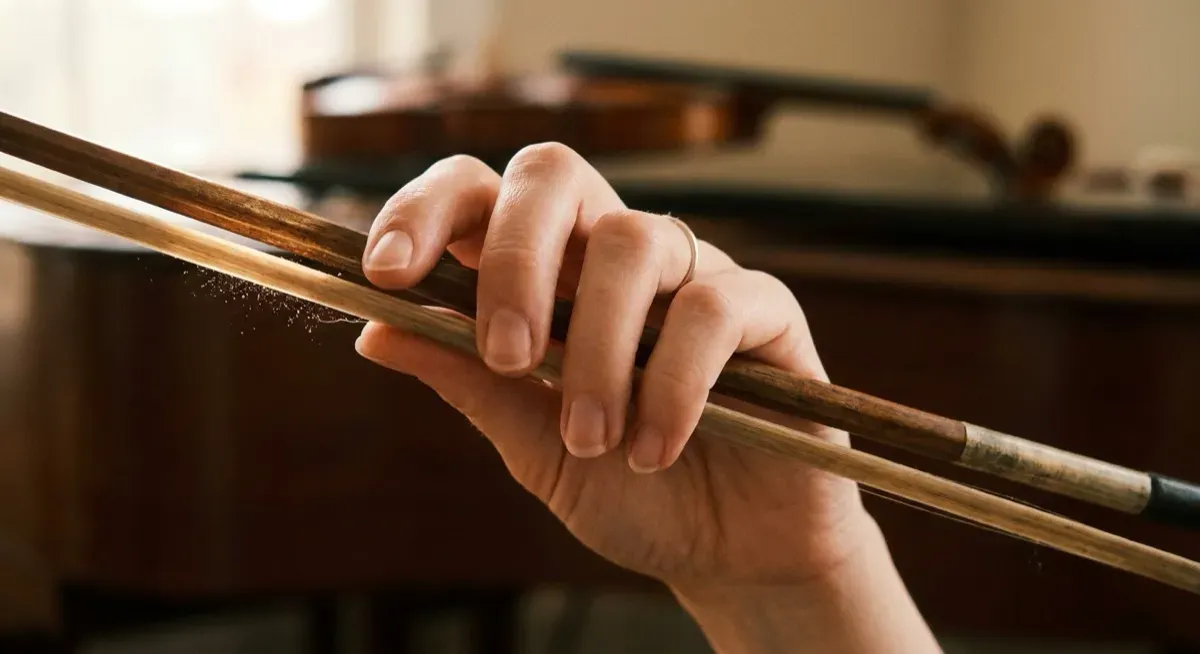
If your violin sounds scratchy, your bow keeps bouncing, or your hand cramps after five minutes, I can almost guarantee the problem is your bow hold. I have been teaching since 2012, and this is the single thing I correct more than anything else. Every week. Sometimes every lesson.
But here’s the good news that keeps me excited about teaching this. Fix your bow hold and everything else gets easier. Everything. Your tone, your confidence, your enjoyment of playing. It all starts here.
Why This One Thing Matters So Much
Your right hand controls tone, volume, articulation, and expression. All of it. Every feeling you want to communicate through music goes through your bow hand first. A tense bow hold produces a tight, scratchy sound no matter how perfectly your left hand is doing its job. A relaxed, balanced hold lets the bow do the work, and the sound opens up in a way that genuinely gives me chills, even after all these years.
Think of it this way. The bow weighs about 60 grams. That’s lighter than your phone. You’re guiding it, not gripping it. The moment my students truly get this, and I can see it in their faces when it clicks, their sound transforms. Sometimes in a single lesson.
Mistake #1. The Death Grip
This is the one I see in probably 80% of new students. Squeezing the bow like it might fly across the room. Knuckles go white, hand cramps within minutes, sound is forced and scratchy. I always wonder if people think the bow is trying to escape.
The fix feels weird at first, and I won’t lie about that. Try holding the bow with just your thumb and middle finger. That’s roughly how much pressure you actually need. Everything else, the other fingers, they’re there for balance and guidance, not force.
I have students practice this for one minute before every session. Just one minute. Within a week, something starts to shift. The grip softens. The sound breathes. It’s one of my favorite transformations to watch.
Mistake #2. Straight Pinky
Your right pinky should sit on top of the stick with a gentle curve. When I see a straight, locked pinky during a lesson, I already know what’s going to happen. The student has no control over the bow’s weight at the frog, and everything feels heavy and uneven.
Your pinky is a counterweight. At the frog, the end near your hand, it balances the bow so it doesn’t dig into the string. Without that balance, you compensate with pressure from other fingers, and the whole system falls apart. It’s like trying to steer a car with your elbows.
Place your pinky on top of the stick. Soft curve. It should feel like it’s resting, not pressing. If it keeps straightening out, and it will at first, take a break and shake your hand out. Your muscles need time to learn this new position. Be patient with them.
Mistake #3. Collapsed Thumb
Your right thumb should be bent, touching the stick at the contact point near the frog. I see a lot of students with their thumb straight or hyperextended, just totally collapsed. This removes all your leverage and control.
Put your thumb opposite your middle finger. Keep it bent. I know it feels unnatural. If it keeps collapsing, here’s something I tell my students that actually works. Practice away from the violin. Hold a pencil the same way for a couple minutes while watching TV. Low pressure, no performance anxiety, just letting your thumb build the muscle memory. It sounds silly but it genuinely helps.
Mistake #4. Bunched Fingers
All four fingers squeezed together in one spot. I call this the “fist hold” and it makes me a little sad every time I see it, because the student is working so hard but their fingers can’t do their jobs this way.
Here’s the thing. Each finger has a specific role. Your index finger adds weight for louder playing. Your pinky balances at the frog. The middle fingers stabilize everything. They need space between them to work independently, like a team where everyone has their own task.
Spread them naturally along the stick. Don’t force them apart, because that creates its own tension, but don’t let them bunch up either. Think of how your hand rests naturally on a table, with fingers slightly apart, relaxed. That’s closer to what we want.
Mistake #5. Frozen Wrist
A stiff wrist means your entire arm moves as one rigid unit. Jerky bow changes, harsh sound at the frog and tip, no ability to play smoothly. I can always spot this one from across the room. The arm moves like a robot instead of flowing.
Your wrist needs to be flexible, especially where the bow changes direction. Try this. Hold the bow and move just your wrist, like a slow windshield wiper. The stick moves but your forearm stays still. This motion is what makes bow changes smooth and silent. It’s the difference between a choppy sound and one that sings.
When a student gets this for the first time, you can hear it immediately. The bow changes go from “click” to invisible. It’s a beautiful moment.
The 2-Minute Daily Check
I give this to every student and I do it myself before every practice.
- Pick up the bow with your left hand, hold it horizontal
- Place your right hand with thumb bent, fingers curved and spaced, pinky on top
- Let go with the left hand and balance the bow with just your right hand
- Slowly tilt the stick up and back down, like a helicopter blade
- If it feels wobbly, check your pinky and thumb first
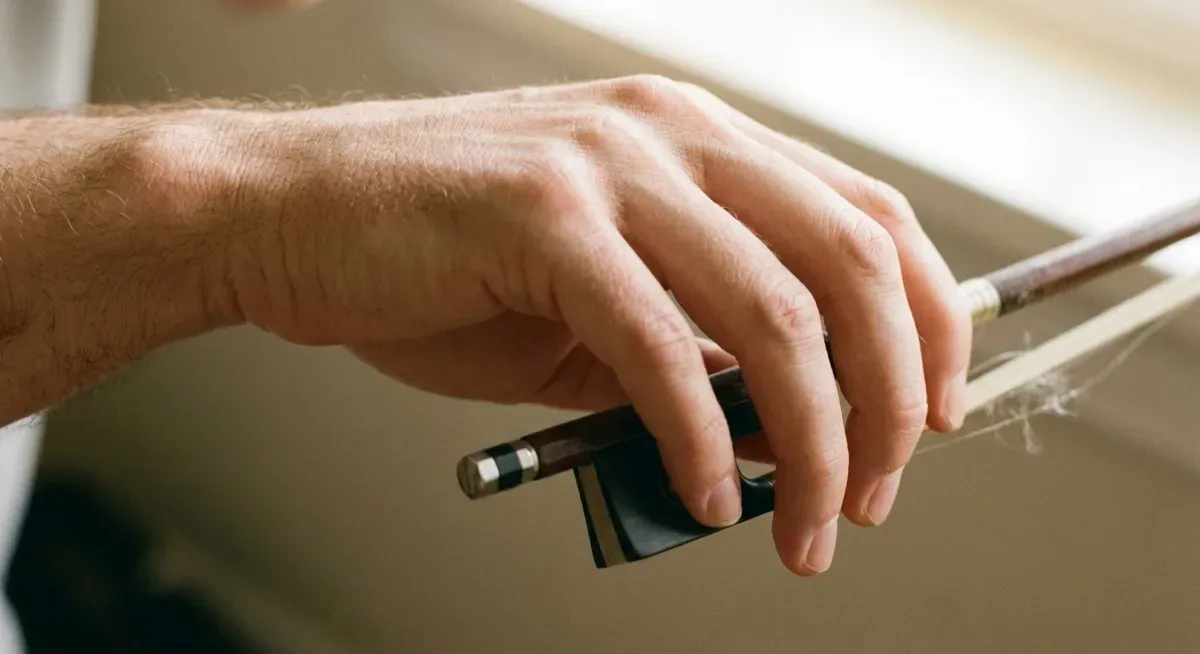
Two minutes. That’s it. It reinforces the correct hold before you play a single note. I’ve been playing for over 30 years and I still do this. Not because I have to, but because it centers me. It’s like a little ritual that says “ok, we’re making music now.”
When Something Sounds Off, Check Here First
Quick diagnostic that saves my students a lot of frustration.
Scratchy tone? Probably gripping too hard. Shake out your hand, take a breath, reset.
Bow bouncing? Pinky might be off the stick, or thumb collapsed. Check both.
Hand cramping? Death grip. You’re working too hard. Remember, 60 grams. Lighter than your phone.
Can’t play softly? Index finger pressing too much, pinky not balancing. Lighten the index, engage the pinky.
Nine times out of ten, when something sounds wrong, the answer is somewhere in the bow hold. Fix it there before blaming anything else. I can’t tell you how many times a student has said “I think my violin is broken” and it was just a tense hand.
The first video in my free beginner series covers bow hold in detail. I walk you through the exact hand placement step by step, close-up so you can follow along.
Struggling with this and want real-time feedback? Book a lesson with me. Bow hold is honestly one of those things that’s so much easier to fix when someone is watching and can say “right there, that’s it.”